Maximillien de Lafayette Books in Sumerian
Books by subject and field:
Index I
Ancient Civilizations, Religion, Sociology & History I
Societies, People, Celebrities, Nations, and Lifestyles I Arts
I Showbiz,
Entertainment, Cinema, Performing Arts, Music, Opera, Theater, Hollywood, Stars I
Dictionaries, Ancient Languages I
Anunnaki and Ulema Anunnaki
I UFOs, Alien &
Extraterrestrials I
Spirituality,
Philosophy, Mysticism, Healing, Metaphysics, Energy, Occult, Science of Mind I
Hospitality, Hotels,
Restaurants, Leadership, Food &
Beverage I Books
in Spanish I Books
at lulu.com I
De
Lafayette bestsellers I
More best
sellers on the next page I
More bestsellers P3 I
Amazon 100 TOP RATED IN UFOs/Best 100 Books in UFOs I Sold
out I
Sold out Part 2
I Books
in Spanish I
De
Lafayette Radio Show I
BOOKS: Coming Soon I
MARIA ORSIC I
Social register of the 500... I
UFOs & SUPERNATURAL MAGAZINE I
Amazon.com Hot New
Releases: The best-selling new & future releases in UFOs.I Hottest
bestsellers on amazon.com I
BESTSELLING AUTHOR IN FRANCE I Contact: delafayette6@aol.com
______________________________________________________________________________________________________________________________________________________________________________
Hard copy: Explanation of Sumerian Tablets, Slabs and seals and
Translation of Cuneiform Inscriptions. Vol1. Available at amazon.com, barnes&noble,
and lulu.com
http://www.lulu.com/shop/maximillien-de-lafayette/explanation-of-sumerian-tablets-slabs-and-seals-and-translation-of-cuneiform-inscriptions-vol1/paperback/product-21776752.html
Ebook Kindle Edition:

Hard copy: Explanation of Sumerian Tablets, Slabs and seals and
Translation of Cuneiform Inscriptions. Vol2. Available at amazon.com, barnes&noble,
and lulu.com
http://www.lulu.com/shop/maximillien-de-lafayette/explanation-of-sumerian-tablets-slabs-and-seals-and-translation-of-cuneiform-inscriptions/paperback/product-21776771.html
Ebook Kindle Edition:

_______________
__________________________
_____________________________________________________________________________________________________________________________
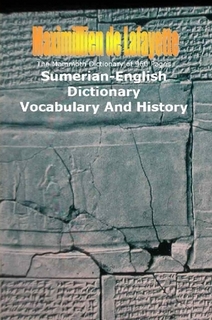
PART 1: University Edition 1 (960 Pages).
Sumerian-English Dictionary: Vocabulary And History. (Comparative Lexicon of
Sumerian, Akkadian, Assyrian, Babylonian, ... Ugaritic, Hittite, Aramaic,
Syriac, Hebrew)
Part 1. The Mammoth Dictionary of 960 Pages. Sumerian-English Dictionary:
Vocabulary & History
Paperback:
http://www.lulu.com/shop/maximillien-de-lafayette/the-mammoth-dictionary-of-960-pages-sumerian-english-dictionary-vocabulary-history/paperback/product-20661160.html
Paperback
at www.lulu.com
Comparative Lexicon of Sumerian, Akkadian, Assyrian, Babylonian, Chaldean,
Phoenician, Ugaritic, Hittite, Aramaic, Syriac, Hebrew, Arabic. A massive
dictionary of 960 pages, previously published in 4 volumes by Times Square
Press. New York, Berlin, Paris. De Lafayette Sumerian-English Dictionary is
a major & unprecedented accomplishment in the fields of linguistics &
comparative study of ancient languages and civilizations; it is a
Comparative Lexicon of Sumerian, Akkadian, Assyrian, Babylonian, Chaldean,
Phoenician, Ugaritic, Hittite, Aramaic, Syriac, Hebrew, Arabic. It is
unique, because it does not only translate & define Sumerian words, but also
tells us how and where from, the Sumerian words originated and their
derivations, and refers us to similar words (Similar meaning, writing and
pronunciations) found in the languages of the ancient world.
Here are samples of how the dictionary lists and defines Sumerian words and
references made to other ancient languages:
* Habiru, "Eberu", "Ebara", "Apiru", "Habiri": Noun.
* Akkadian/Assyrian/Proto Hebrew/Egyptian/Sumerian/
* Akkadian/Phoenician/Semite.
* Name of the early Jews/Hebrews.
* Derived from the Akkadian word Ebara, usually referring to the early
Hebrews/Jews who crossed the desert of Sinai.
* Habiru means those who traversed or crossed a land or a river. 'Aber in
Arabic means the person who crossed or traveled a land.
* The Assyrian verb is Ebro, meaning to cross; it is a contemporary Assyrian
Western dialect.
* Ebara in contemporary Assyrian Eastern dialect.
* Eberu in Akkadian.
* Abra in Arabic.
* The verb is Eberu in Akkadian/Assyrian.
* a- To cross
over.
* b- To traverse.
* Ebara in contemporary Assyrian Eastern dialect.
* Ebro in contemporary Assyrian Western dialect.
* 'Aber in Arabic means the person who crossed or traveled a land.
* 'Aabiroun in plural.
* Ama: Noun. Mother.
* Ima in Hebrew.
* Ama in ancient Syriac.
* Ummum in Akkadian.
* Oum in literary/written Arabic, and Mama in spoken Arabic.
* Anna in Hittite.
* Bit: Sumerian/Assyrian. Noun. A house.
* Beit in Hebrew.
* Beyt, Bayt and Beit in Arabic.
* Bet, Bayto and Bayta in ancient Aramaic.
* Bitu in ancient Akkadian.
* Shamash: Noun. Sumerian/Assyrian/Akkadian.
* In the Sumerian mythology, he is associated with god Utu. (d ama, in
Akkadian) Shamash is the sun god, and the son of Sin and Ningal, created by
the Anunnaki.
* In Akkadian and Sumerian, Shamash means the sun.
* From Shamash, derived the:
* a- Arabic word Shams "Chams", which means the sun.
* b- Hebrew word Shemesh, which means the sun. The Hebraic city of Beit
Shemesh (Beit means house, but here, it means temple. Shemesh means sun) was
named after the Canaanite sun goddess Shemesh.
* c- Aramaic word sheh'-mesh, which also means the sun.
* d- Phoenician and Ugaritic words Shem and Shema, which mean the sun and
are used as a symbol for the heavens.
* Etymologically, all these words derived from the Ana'kh word Shama, which
means either the sun or the heavens (Sky). In the Akkadian/Sumerian clay
tablets, Shamash is depicted as "the supreme judge of heaven and earth", and
"the lord of all living creatures."
In addition, the dictionary tells us how words were used, who used them and
where did those words appear in epics & clay tablets.
* Gabsu "Gabsa": Adverb. Adjective. Sumerian/Assyrian
* Meaning: Mighty, Large, Strong.
* "Edu gabshu sha mahira la ishu." Annals of Sardanapalus. "Mighty leader,
who has no rival."
*"Kizir shunu gabsha lu pirisha." From the Annals of Tiglath Pileser. "I
broke through their large body."
* "Itti umanate-shunu gabshate ina er va shade huris lu amdahiz." Annals of
Tiglath Pileser. "I victoriously fought with their strong soldiers in city
and mountain ."

 PART
2: University Edition 1 (960 Pages). Sumerian-English Dictionary: Vocabulary And
History. (Comparative Lexicon of Sumerian, Akkadian, Assyrian, Babylonian, ...
Ugaritic, Hittite, Aramaic, Syriac, Hebrew)
PART
2: University Edition 1 (960 Pages). Sumerian-English Dictionary: Vocabulary And
History. (Comparative Lexicon of Sumerian, Akkadian, Assyrian, Babylonian, ...
Ugaritic, Hittite, Aramaic, Syriac, Hebrew)
Part 2. The Mammoth Dictionary of 960 Pages. Sumerian-English Dictionary:
Vocabulary & History
_____________________________________________________________________________________________________________________________-
Vol.13 Thesaurus-Dictionary of Sumerian Anunnaki
Babylonian Assyrian Mesopotamian Phoenician Aramaic Akkadian Anatolian Hittite
Chaldean Arabic Syriac and Hebrew Languages & Civilization.
Kindle edition:
http://www.amazon.com/Thesaurus-Dictionary-Babylonian-Mesopotamian-Civilizations-ebook/dp/B00A57PCYM/ref=sr_1_4?s=books&ie=UTF8&qid=1353723536&sr=1-4&keywords=maximillien+de+lafayette
Paperback:
http://www.lulu.com/shop/maximillien-de-lafayette/thesaurus-dictionary-of-sumerian-anunnaki-babylonian-assyrian-mesopotamian-phoenician-aramaic-akkadian-anatolian-hittite/paperback/product-20503553.html
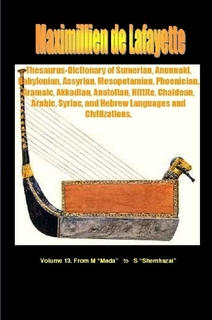 Vol.13.
Thesaurus-Dictionary of Sumerian Anunnaki Babylonian Assyrian Mesopotamian
Phoenician Aramaic Akkadian Anatolian Hittite Chaldean Arabic Syriac and Hebrew
Languages and Civilizations. Published by Times Square Press, Berlin, New York.
Volume 13 from a set of 14 volumes. From M “Mada” to S “Shemhazai”. (The set:
Approximately 4,500 pages). Paperback is available at www.lulu.com and
worldwide. Nothing like it under the sun. World premiere. Anunnaki and ancient
civilizations secrets; hundreds of in-depth thematic articles, translation of
tablets & epics, thousands upon thousands of words’ terminologies, analogies and
definitions in 14 languages: Sumerian Anunnaki Babylonian Mesopotamian Assyrian
Akkadian Aramaic Hittite Anatolian Phoenician Chaldean Arabic Syriac Hebrew,
Ana'kh the Anunnaki language & their relation to history, civilizations and
extraterrestrials.
Vol.13.
Thesaurus-Dictionary of Sumerian Anunnaki Babylonian Assyrian Mesopotamian
Phoenician Aramaic Akkadian Anatolian Hittite Chaldean Arabic Syriac and Hebrew
Languages and Civilizations. Published by Times Square Press, Berlin, New York.
Volume 13 from a set of 14 volumes. From M “Mada” to S “Shemhazai”. (The set:
Approximately 4,500 pages). Paperback is available at www.lulu.com and
worldwide. Nothing like it under the sun. World premiere. Anunnaki and ancient
civilizations secrets; hundreds of in-depth thematic articles, translation of
tablets & epics, thousands upon thousands of words’ terminologies, analogies and
definitions in 14 languages: Sumerian Anunnaki Babylonian Mesopotamian Assyrian
Akkadian Aramaic Hittite Anatolian Phoenician Chaldean Arabic Syriac Hebrew,
Ana'kh the Anunnaki language & their relation to history, civilizations and
extraterrestrials.
_____________________________________________________________________________________________________________
Vol.14 Thesaurus-Dictionary of Sumerian Anunnaki
Babylonian Assyrian Mesopotamian Phoenician Aramaic Akkadian Anatolian Hittite
Chaldean Arabic Syriac and Hebrew Languages & Civilization.
Kindle edition:
http://www.amazon.com/Thesaurus-Dictionary-Babylonian-Mesopotamian-Civilizatio-ebook/dp/B00A5FEQKU/ref=sr_1_2?s=books&ie=UTF8&qid=1353723536&sr=1-2&keywords=maximillien+de+lafayette
Paperback:
http://www.lulu.com/shop/maximillien-de-lafayette/vol14-thesaurus-dictionary-of-sumerian-anunnaki-babylonian-assyrian-mesopotamian-phoenician-aramaic-akkadian-anatolian-hittite/paperback/product-20503875.html
 Vol.14
(Final Part) Thesaurus-Dictionary of Sumerian Anunnaki Babylonian Assyrian
Mesopotamian Phoenician Aramaic Akkadian Anatolian Hittite Chaldean Arabic
Syriac and Hebrew Languages and Civilizations. Published by Times Square Press,
Berlin, New York. Volume 14 from a set of 14 volumes. From S to Z. (The set:
Approximately 4,500 pages). Paperback is available at www.lulu.com and
worldwide. Nothing like it under the sun. World premiere. Anunnaki and ancient
civilizations secrets; hundreds of in-depth thematic articles, translation of
tablets & epics, thousands upon thousands of words’ terminologies, analogies and
definitions in 14 languages: Sumerian Anunnaki Babylonian Mesopotamian Assyrian
Akkadian Aramaic Hittite Anatolian Phoenician Chaldean Arabic Syriac Hebrew,
Ana'kh the Anunnaki language & their relation to history, civilizations and
extraterrestrials.
Vol.14
(Final Part) Thesaurus-Dictionary of Sumerian Anunnaki Babylonian Assyrian
Mesopotamian Phoenician Aramaic Akkadian Anatolian Hittite Chaldean Arabic
Syriac and Hebrew Languages and Civilizations. Published by Times Square Press,
Berlin, New York. Volume 14 from a set of 14 volumes. From S to Z. (The set:
Approximately 4,500 pages). Paperback is available at www.lulu.com and
worldwide. Nothing like it under the sun. World premiere. Anunnaki and ancient
civilizations secrets; hundreds of in-depth thematic articles, translation of
tablets & epics, thousands upon thousands of words’ terminologies, analogies and
definitions in 14 languages: Sumerian Anunnaki Babylonian Mesopotamian Assyrian
Akkadian Aramaic Hittite Anatolian Phoenician Chaldean Arabic Syriac Hebrew,
Ana'kh the Anunnaki language & their relation to history, civilizations and
extraterrestrials.
What the scholars and authors wrote about this most astonishing
and unique thesaurus:
• Rating: 5 stars. Dr. Lynne Kitei wrote: “Acclaimed linguist and
scholar, Maximillien de Lafayette, has created a unique Thesaurus/Dictionary for
the ages. This historical volume is monumental. Lending credibility and factual
confirmation to the topic, Maximillien has filled the deep chasm that has been
so prevalent in the archives of linguistics, as well as extraterrestrial
education. With an emphasis on ancient data and language, this accomplished
historian mastered an astounding feat. He is to be lauded as a magnanimous
figure in the annals of both linguistics and Ufology. Having extensively studied the
background of anomalous visitations and influence since becoming a first-hand
witness to the still unexplained Arizona mass UFO sighting of March 13, 1997,
this tremendous resource of information delves much deeper and more succinctly
than any book I have read on the subject. The author creatively translates and
intricately defines fascinating information concerning the significance of not
just one or two languages, but fourteen! He cleverly expounds on the why, where,
when and who of the origins, sources, derivations, uses, and transformation of
these ancient letters and words, while artistically weaving intriguing tales and
mythology. The work behind this tremendous achievement is staggering. I wouldn't
be surprised if this important Thesaurus/Dictionary becomes a collectors item in
short order.” Lynne D. Kitei, M.D., Author & Executive Producer, The Phoenix
Lights Network.
• Rating: 5 stars. “Overwhelmed with this beautiful product…This
is one of the best things that is happening in Amazon, I already have purchased
up to 10 volume of this, and hope Amazon supports the future volumes for us to
be able to complete this investment.
This is actually an encyclopedia which is much bigger than Thesaurus or
dictionary.”- Dr. Beesavad.
• Rating: 5 stars. Author, scholar and playwright Eugenia Macer-Story
wrote, “It is fascinating to leaf through the various alphabetic arrangements,
proceeding in inspirational sequence, and each individual should gain a quite
different (though basically the same) understanding of the cross-referenced
concepts attached to linguistic symbols which seem to have included an
understanding of how the initial Anunnaki promptings might actualize in the long
run of linear time.”
______________________________________________________________________________________________________________
New De
Lafayette Mega Sumerian-English Dictionary in 4 volumes
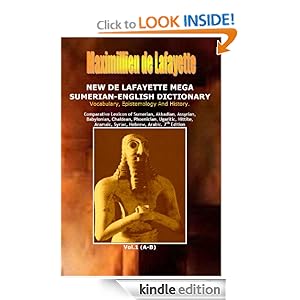
Volume 1: 7th
Edition. New De Lafayette Mega Sumerian-English Dictionary: Vocabulary,
Epistemology And History. Vol.1 (A-B) (Origin, Epistemology, Etymology and
Derivation of Words in Ancient/Dead Languages)
[Kindle Edition]
Kindle Edition:
http://www.amazon.com/Lafayette-Mega-Sumerian-English-Dictionary-ebook/dp/B009SH6SWU/ref=sr_1_12?s=books&ie=UTF8&qid=1352129974&sr=1-12&keywords=maximillien+de+lafayette
 Vol.
1 from a set of 4 volumes of approximately 1000 pages & containing hundreds
upon hundreds of illustrations & photos. New De Lafayette Mega
Sumerian-English Dictionary is a major & unprecedented accomplishment in the
fields of linguistics & comparative study of ancient languages and
civilizations; it is a Comparative Lexicon of Sumerian, Akkadian, Assyrian,
Babylonian, Chaldean, Phoenician, Ugaritic, Hittite, Aramaic, Syriac, Hebrew,
Arabic. It is unique, because it does not only translate & define Sumerian
words, but also tells us how and where from the Sumerian words originated &
their derivations & refers us to similar words (Similar meaning, writing and
pronunciations) found in Akkadian, Assyrian, Babylonian, Chaldean, Phoenician,
Ugaritic, Hittite, Aramaic, Syriac, Hebrew, Arabic. Here are samples of how
the dictionary lists and defines Sumerian words and references made to other
ancient languages:
Vol.
1 from a set of 4 volumes of approximately 1000 pages & containing hundreds
upon hundreds of illustrations & photos. New De Lafayette Mega
Sumerian-English Dictionary is a major & unprecedented accomplishment in the
fields of linguistics & comparative study of ancient languages and
civilizations; it is a Comparative Lexicon of Sumerian, Akkadian, Assyrian,
Babylonian, Chaldean, Phoenician, Ugaritic, Hittite, Aramaic, Syriac, Hebrew,
Arabic. It is unique, because it does not only translate & define Sumerian
words, but also tells us how and where from the Sumerian words originated &
their derivations & refers us to similar words (Similar meaning, writing and
pronunciations) found in Akkadian, Assyrian, Babylonian, Chaldean, Phoenician,
Ugaritic, Hittite, Aramaic, Syriac, Hebrew, Arabic. Here are samples of how
the dictionary lists and defines Sumerian words and references made to other
ancient languages:
* Habiru, "Eberu", "Ebara", "Apiru", "Habiri": Noun.
* Akkadian/Assyrian/Proto Hebrew/Egyptian/Sumerian/
* Akkadian/Phoenician/Semite.
* Name of the early Jews/Hebrews.
* Derived from the Akkadian word Ebara, usually referring to the early
Hebrews/Jews who crossed the desert of Sinai.
* Habiru means those who traversed or crossed a land or a river. 'Aber in
Arabic means the person who crossed or traveled a land.
* The Assyrian verb is Ebro, meaning to cross; it is a contemporary Assyrian
Western dialect.
* Ebara in contemporary Assyrian Eastern dialect.
* Eberu in Akkadian.
* Abra in Arabic.
* The verb is Eberu in Akkadian/Assyrian.
* a- To cross over.
* b- To traverse.
* Ebara in contemporary Assyrian Eastern dialect.
* Ebro in contemporary Assyrian Western dialect.
* 'Aber in Arabic means the person who crossed or traveled a land.
* 'Aabiroun in plural.
* Ama: Noun. Mother.
* Ima in Hebrew.
* Ama in ancient Syriac.
* Ummum in Akkadian.
* Oum in literary/written Arabic, and Mama in spoken Arabic.
* Anna in Hittite.
* Bit: Sumerian/Assyrian. Noun. A house.
* Beit in Hebrew.
* Beyt, Bayt and Beit in Arabic.
* Bet, Bayto and Bayta in ancient Aramaic.
* Bitu in ancient Akkadian.
* Shamash: Noun. Sumerian/Assyrian/Akkadian.
* In the Sumerian mythology, he is associated with god Utu. (d ama, in
Akkadian) Shamash is the sun god, and the son of Sin and Ningal, created by
the Anunnaki.
* In Akkadian and Sumerian, Shamash means the sun.
* From Shamash, derived the:
* a- Arabic word Shams "Chams", which means the sun.
* b- Hebrew word Shemesh, which means the sun. The Hebraic city of Beit
Shemesh (Beit means house, but here, it means temple. Shemesh means sun) was
named after the Canaanite sun goddess Shemesh.
* c- Aramaic word sheh'-mesh, which also means the sun.
* d- Phoenician and Ugaritic words Shem and Shema, which mean the sun and are
used as a symbol for the heavens.
* Etymologically, all these words derived from the Ana'kh word Shama, which
means either the sun or the heavens (Sky). In the Akkadian/Sumerian clay
tablets, Shamash is depicted as "the supreme judge of heaven and earth", and
"the lord of all living creatures."
In addition, the dictionary tells us how words were used, who used them, &
where did they appear in epics & clay tablets.
* Gabsu "Gabsa": Adverb. Adjective. Sumerian/Assyrian
* Meaning: Mighty, Large, Strong.
* "Edu gabshu sha mahira la ishu." Annals of Sardanapalus. "Mighty leader,
who has no rival."
*"Kizir shunu gabsha lu pirisha." From the Annals of Tiglath Pileser. "I
broke through their large body."
* "Itti umanate-shunu gabshate ina er va shade huris lu amdahiz." Annals of
Tiglath Pileser. "I victoriously fought with their strong soldiers in city
and mountain ."
* Habal: Noun Sumerian/Akkadian. Corruption
* "Shuteshur la lihi la habal." Sargina, Khorsabad. "To rule without violence,
without corruption."
Examples of some rich comparative definitions from the book:
Abgal: Noun.
-
A man of wisdom.
-
A sage in the service of a ruler.
Composed of two words:
-
Ab or Aba (Father)
-
Gal (A man who has acquired knowledge and wisdom.)
From Ab, derived the:
-
Hebrew Abba
-
Arabic Ab and Abu
-
Syriac Aba
-
Lebanese-Arabic Ab
-
Aramaic Abba
-
Sumerian Abi and Abu
-
Chaldean Abba
-
Anglo-Saxon Abbot
-
French Abbé and Papa
-
Ancient English Abbad
-
Modern Greek Baba (papas)
-
Italian Abbate
· Hammurabi said: "Abim pi alidi-ya." (Of my father who
begat me.)
In its primitive form, Abgal meant:
-
Leader.
-
Father of the people.
-
Ruler.
-
Chief.
In ancient Sumer, it was used as a title of reverence and respect.
This ancient Sumerian title gave birth to the modern meaning of the word
"Reverend" (Respected or respectable), usually used upon addressing a
pastor.
The Arabs in the Middle and Near East regions call a priest or a pastor
either Ab, Abouna or Mouhtaram.
The word Mouhtaram means respected, reverend.
The Copts (Christian Egyptians) and Ethiopians use the word Abouna or
Abunna (Our father, referring to a priest.)
From Gal, derived the Arabic adjective Ghali which means:
-
Expensive.
-
Important.
-
Dear to loved ones.
Abgal, originally derived from the Anak'h Ab (leader; father) and Gh'al
(From above or from heaven.)
*** *** ***
Anunnaki: Sumerian/Akkadian. Noun. The word Anunnaki is composed
of three words or more, depending on the choice of linguists:
-
1- Anu, which is the name of the Anunnaki's supreme god. And the
epistemological meaning of Anu is: Lord; leader; king.
-
2- Na, is either a verb or an adverb, meaning to send. In many
Akkadian, Sumerian, Assyrian and Old Babylonian texts and
inscriptions, "Na" was written as "Ina", and meant in, from within, so
on.
-
3- Ki, generally means Earth in Akkadian and Sumerian. But Ki also
means, in Akkadian and Sumerian:
-
a-The underworld,
-
b- The netherworld,
-
c- The world of death.
-
These three words were commonly referred to as KURNUGI (Kurnu-Ki),
meaning hell and the land of no return.
The Akkadian/Sumerian Anunnaki word is used in a plural form to
represent the gods of heaven and Earth, known as ANUNA, and are
represented as a amê u erSetim, meaning of heaven and earth.
-
a amê means heaven or sky in Akkadian and Sumerian.
-
Shem and shama in Phoenician,
-
Sama in Arabic.
ErSetim means earth.
Thus, the Anunnaki and Igigi are grouped together under Anunna.
Later on in history, and in order to differentiate between the Anunnaki
and the Igigi;
-
The scribes called the Anunnaki, the gods of Earth, also gods of the
netherworld, and gods of the Empire of Death;
-
The scribes called the Igigi, gods of the Heaven.
This differentiation is very clear in all the Mesopotamian clay tablets,
particularly in the Ishtar Descent to the Underworld (Ki), the poem/myth
of Gilgamesh, the Enuma Elish, etc...
Other names of the Anunnaki:
The Anunnaki were known to many neighboring countries in the Near East,
Middle East, and Anatolia.
And because of the languages' differences, the Anunnaki were called
differently.
-
1-The Habiru (Early Hebrews/Israelites) called them Anakim and
Nephilim, meaning to fall down to earth.
-
2-Some passages in the Old Testament refer to them as Elohim.
-
3-In Ashuric (Assyrian-Chaldean), and Syriac-Aramaic, they are
called Jabaariyn, meaning the mighty ones.
-
4-In Aramaic, Chaldean and Hebrew, the Anunnaki as Gibborim
mean the mighty or majestic ones.
-
5-In literary Arabic, it is Jababira. The early Arabs called
them Al Jababira; sometimes Amalika.
-
6-The Egyptians called them Neteru.
-
7-The early Phoenicians called them An.Na Kim, meaning the god
or heaven who sent them to us.
-
8-The early inhabitants of Arwad called then Anu.ki, meaning
the subjects or followers of Anu. Sometimes, they were called Anu.
Ki.ram. (Ram means people, persons, community, tribes, group)
-
9-The early Hyksos (Ancestors of the Armenians) who invaded and
ruled Egypt, called them the Anuramkir and Anuramkim, meaning the
people of Anu on earth. It is composed of three words: Anu + ram
(People) + Ki (Earth). The primitive form of Ki was kir or kiim.
-
10-The Greeks called them the Annodoti.
-
11- In the Book of Enoch, they are called The Nephilim, "The
Sons of God," or the "Watchers".
-
12-The Ulema call them Annakh or Al Annaki, meaning the people
from above.
-
13-In other parts of Anatolia, and especially in the lands of
the Hittites, the Anunnaki were also called Anunnaku, and Ananaki.
The Annunaki appeared in the Babylonian creation myth/epic, "Enuma
Elish". In the late version, glorifying Marduk, after the creation of
mankind, Marduk divides the Anunnaki and assigns them to diverse parts
of the earth.
According to later Babylonian myths, the Anunnaki were the children of
Anu and Ki, brother and sister gods, themselves the children of Anshar
and Kishar (Skypivot and Earthpivot) who were the children of Lahm and
Lahmu, names/titles bestowed upon the gatekeepers of the Abzu temple
at Eridu.
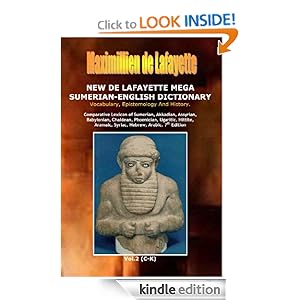 Volume
2: 7th Edition. New De Lafayette Mega Sumerian-English Dictionary:
Vocabulary, Epistemology And History. Vol.2 (C-K) (Origin, Epistemology,
Etymology and Derivation of Words in Ancient/Dead Languages)
Volume
2: 7th Edition. New De Lafayette Mega Sumerian-English Dictionary:
Vocabulary, Epistemology And History. Vol.2 (C-K) (Origin, Epistemology,
Etymology and Derivation of Words in Ancient/Dead Languages)
http://www.amazon.com/Lafayette-Mega-Sumerian-English-Dictionary-ebook/dp/B009SCN21K/ref=sr_1_15?s=books&ie=UTF8&qid=1352134053&sr=1-15&keywords=maximillien+de+lafayette
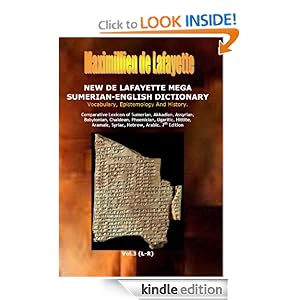 Volume
3 : 7th
Edition. New De Lafayette Mega Sumerian-English Dictionary: Vocabulary,
Epistemology And History. Vol.3 (L-R) (Origin, Epistemology, Etymology and
Derivation of Words in Ancient/Dead Languages)
Volume
3 : 7th
Edition. New De Lafayette Mega Sumerian-English Dictionary: Vocabulary,
Epistemology And History. Vol.3 (L-R) (Origin, Epistemology, Etymology and
Derivation of Words in Ancient/Dead Languages)
http://www.amazon.com/Lafayette-Mega-Sumerian-English-Dictionary-ebook/dp/B009SH6VAO/ref=sr_1_13?s=books&ie=UTF8&qid=1352134177&sr=1-13&keywords=maximillien+de+lafayette
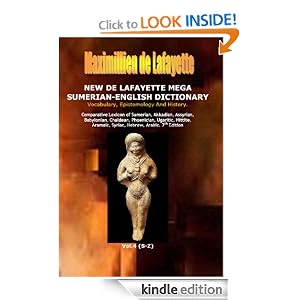 Volume
4 :
7th Edition. New De Lafayette Mega Sumerian-English Dictionary: Vocabulary,
Epistemology And History. Vol.4 (S-Z) (Origin, Epistemology, Etymology and
Derivation of Words in Ancient/Dead Languages)
[Kindle Edition]
Volume
4 :
7th Edition. New De Lafayette Mega Sumerian-English Dictionary: Vocabulary,
Epistemology And History. Vol.4 (S-Z) (Origin, Epistemology, Etymology and
Derivation of Words in Ancient/Dead Languages)
[Kindle Edition]
http://www.amazon.com/Lafayette-Mega-Sumerian-English-Dictionary-ebook/dp/B009SH6XIE/ref=sr_1_14?s=books&ie=UTF8&qid=1352134177&sr=1-14&keywords=maximillien+de+lafayette
____________________________________________________________________________________________________________
SUMERIAN-ENGLISH DICTIONARY:
VOCABULARY, AND HISTORY (4 Volumes)
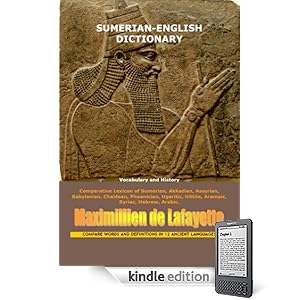 VOLUME
1: SUMERIAN-ENGLISH
DICTIONARY: VOCABULARY, AND HISTORY. Comparative Lexicon of Sumerian, Akkadian,
Assyrian, Babylonian, Chaldean, Phoenician, Ugaritic, Hittite, Aramaic, Syriac,
Hebrew, Arabic.
VOLUME
1: SUMERIAN-ENGLISH
DICTIONARY: VOCABULARY, AND HISTORY. Comparative Lexicon of Sumerian, Akkadian,
Assyrian, Babylonian, Chaldean, Phoenician, Ugaritic, Hittite, Aramaic, Syriac,
Hebrew, Arabic.
Kindle Edition:
http://www.amazon.com/SUMERIAN-ENGLISH-DICTIONARY-Comparative-ebook/dp/B004NBZAUW/ref=sr_1_2?ie=UTF8&m=AG56TWVU5XWC2&s=digital-text&qid=1298198938&sr=1-2
Paperback:
http://www.lulu.com/product/paperback/sumerian-english-dictionary-vocabulary-and-history/14925144
COMPARE WORDS AND DEFINITIONS IN 12 ANCIENT LANGUAGES
Volume 1 from a set of 4: A most unique dictionary of the Sumerian language on
many levels; mainly because of its comparison and analogy between Sumerian and
12 languages of the ancient world, such as, Akkadian, Assyrian, Babylonian,
Chaldean, Phoenician, Ugaritic, Hittite, Aramaic, Syriac, Hebrew, Arabic.
Written by a scholar who has to his credits 600 published books, and 9
dictionaries on the languages of the Near East, Middle East, Asia Minor and
Europe.
The dictionary is in Latin script. Thousands of entries,
definitions and epistemological explanation of the origin of the word, its
derivation and variants in other languages. Abundance of photos, maps,
illustrations and sketches.
 VOLUME
2: SUMERIAN-ENGLISH
DICTIONARY: VOCABULARY, AND HISTORY. Comparative Lexicon of Sumerian, Akkadian,
Assyrian, Babylonian, Chaldean, Phoenician, Ugaritic, Hittite, Aramaic, Syriac,
Hebrew, Arabic.
VOLUME
2: SUMERIAN-ENGLISH
DICTIONARY: VOCABULARY, AND HISTORY. Comparative Lexicon of Sumerian, Akkadian,
Assyrian, Babylonian, Chaldean, Phoenician, Ugaritic, Hittite, Aramaic, Syriac,
Hebrew, Arabic.
Paperback:
http://www.lulu.com/product/paperback/sumerian-english-dictionary-vol-2-vocabulary-and-conversation/15534974
Volume 2. from a set of 3 volumes. SUMERIAN-ENGLISH
DICTIONARY: VOCABULARY, AND HISTORY. Comparative Lexicon of Sumerian,
Akkadian, Assyrian, Babylonian, Chaldean, Phoenician, Ugaritic, Hittite,
Aramaic, Syriac, Hebrew, Arabic. A most unique dictionary of the Sumerian
language on many levels; mainly because of its comparison and analogy between
Sumerian and 12 languages of the ancient world, such as, Akkadian, Assyrian,
Babylonian, Chaldean, Phoenician, Ugaritic, Hittite, Aramaic, Syriac, Hebrew,
Arabic. Written by a scholar who has to his credits 600 published books, and 9
dictionaries on the languages of the Near East, Middle East, Asia Minor and
Europe. The dictionary is in Latin script. Thousands of entries, definitions
and epistemological explanation of the origin of the word, its derivation and
variants in other languages. Abundance of photos, maps, illustrations and
sketches.
Kindle Edition:
http://www.amazon.com/SUMERIAN-ENGLISH-DICTIONARY-HISTORY-Comparative-ebook/dp/B004XMOZI4/ref=sr_1_7?ie=UTF8&m=AG56TWVU5XWC2&s=digital-text&qid=1304803992&sr=1-7
VOLUME 3:
SUMERIAN-ENGLISH DICTIONARY: VOCABULARY, AND HISTORY. Comparative Lexicon of
Sumerian, Akkadian, Assyrian, Babylonian, Chaldean, Phoenician, Ugaritic, Hittite, Aramaic, Syriac,
Hebrew, Arabic. (L-R)
/15669024/thumbnail/320) Paperback:
http://www.lulu.com/product/paperback/sumerian-english-dictionary-vol3-%28l-r%29/15669024
Paperback:
http://www.lulu.com/product/paperback/sumerian-english-dictionary-vol3-%28l-r%29/15669024
COMPARE WORDS AND DEFINITIONS IN 12 ANCIENT LANGUAGES
Volume 3 from a set of 4 volumes: A most unique dictionary of the Sumerian
language on many levels; mainly because of its comparison and analogy between
Sumerian and 12 languages of the ancient world, such as, Akkadian, Assyrian,
Babylonian, Chaldean, Phoenician, Ugaritic, Hittite, Aramaic, Syriac, Hebrew,
Arabic. Written by a scholar who has to his credits 715 published books, and 9
dictionaries on the languages of the Near East, Middle East, Asia Minor and
Europe. The dictionary is in Latin script. Thousands of entries, definitions
and epistemological explanation of the origin of the word, its derivation and
variants in other languages. Abundance of photos, maps, illustrations and
sketches.
Kindle Edition:
http://www.amazon.com/SUMERIAN-ENGLISH-DICTIONARY-Three-ebook/dp/B004ZRLUSU/ref=sr_1_1?ie=UTF8&m=AG56TWVU5XWC2&s=digital-text&qid=1304803992&sr=1-1
Sumerian-English Dictionary: Vocabulary And
History. Vol. 4 (Letters S-Z)
/15991877/thumbnail/320.jpg) Paperback:
http://www.lulu.com/product/paperback/sumerian-english-dictionary-vocabulary-and-history-vol-4-%28letters-s-z%29/15991877
Paperback:
http://www.lulu.com/product/paperback/sumerian-english-dictionary-vocabulary-and-history-vol-4-%28letters-s-z%29/15991877
Sumerian-English Dictionary: Vocabulary, And History. Vol.
4 (Letters S-Z) Comparative Lexicon of Sumerian, Akkadian, Assyrian,
Babylonian, Chaldean, Phoenician, Ugaritic, Hittite, Aramaic, Syriac, Hebrew,
Arabic. COMPARE WORDS AND DEFINITIONS IN 12 ANCIENT LANGUAGES A most unique
dictionary of the Sumerian language on many levels; mainly because of its
comparison and analogy between Sumerian and 12 languages of the ancient world,
such as, Akkadian, Assyrian, Babylonian, Chaldean, Phoenician, Ugaritic,
Hittite, Aramaic, Syriac, Hebrew, Arabic. Written by a scholar who has to his
credits 800 published books, and 9 dictionaries on the languages of the Near
East, Middle East, Asia Minor and Europe. The dictionary is in Latin script.
Thousands of entries, definitions and epistemological explanation of the
origin of the word, its derivation and variants in other languages. Abundance
of photos, maps, illustrations and sketches.
Maximillien de Lafayette new
books in foreign languages French
Français , German
Deutsch, Italian Italiano, Spanish
Español , Russian
Pусский , Portuguese Português ,Turkish
Türk , etc.)
Czech ,
Slovak